HyperClapper + Hypelio: A Smarter Way to Grow on LinkedIn
Discover how social media automation LinkedIn tools like Hypelio help you grow smarter, save time, and boost engagement without the manual grind. Start working smarter.
The Hypelio team
November 18, 2026
HyperClapper + Hypelio: A Smarter Way to Grow on LinkedIn
📅 ⏱ 12 min read📝 ~2300 words
Most LinkedIn growth stacks have a gap in the middle. Hyperclapper — a LinkedIn pod automation tool that drives early engagement velocity on posts to signal relevance to the algorithm — handles the trigger side well. But it cannot write the post, get it approved, or publish it at the right moment. That is where the combination falls apart for most practitioners. Hypelio, a LinkedIn content management platform built for agencies, ghostwriters, and founders, fills that gap precisely. Together, Hypelio and Hyperclapper form a complete social media automation LinkedIn stack — one that handles content authentically and amplifies it systematically.
Who this is for: Ghostwriters, agencies, and founders managing LinkedIn for themselves or clients — especially those already using Hyperclapper.
What you'll learn: How Hypelio and Hyperclapper fit together as a workflow, and what each tool actually does in the stack.
The core argument: Hyperclapper amplifies posts; Hypelio makes those posts worth amplifying — and schedules them at the moment amplification works best.
Safety reality: Content scheduling and approval workflows carry a fundamentally different risk profile than outreach bots — most guides never make this distinction clearly.
Most counterintuitive finding: The biggest organic reach driver on LinkedIn is consistent publishing cadence — and that is precisely what most manual agency workflows fail to maintain under client load.
Pricing angle: Hypelio's per-account billing structure makes it more cost-effective at scale than alternatives like Taplio or Supergrow.
What Hypelio and Hyperclapper Actually Are (And Why They Work Better Together)
What Hypelio and Hyperclapper Actually Are
Hyperclapper is a LinkedIn pod automation tool — meaning it coordinates a group of real LinkedIn users who automatically engage with each other's posts in the first window after publication, boosting early engagement velocity. Engagement velocity is the speed at which a post receives likes and comments after publishing; LinkedIn's algorithm reads high early velocity as a signal that content is relevant and worth distributing more widely.
Hyperclapper handles that trigger well. What it does not do is write the post, capture the author's authentic voice, route it through an approval process, or publish it at the precise audience-activity window where the pod engagement will have maximum effect. That is a significant operational gap for anyone managing LinkedIn at scale.
Hypelio fills it. It is a LinkedIn content management platform built specifically for agencies, ghostwriters, and founders managing multiple client profiles. Its standout capability is a story bank system — voice recordings captured verbatim, turned into drafts that use the author's own phrasing rather than generic AI output. That authenticity matters more than it might seem, which the next section explains in detail.
💡
Pro Tip:Hypelio is rated 4.8/5 on G2 and used by professionals at Google, Meta, Goldman Sachs, and Accenture. If enterprise credibility matters to your agency pitch, that is a useful data point to have.
Hypelio Features and Benefits at a Glance
Story bank: Captures voice recordings verbatim — AI drafts are built from the author's own words, not model defaults.
Multi-account workspaces: Manage multiple LinkedIn profiles under one login without ever holding client passwords.
Client approval workflow: Drafts are sent via link for sign-off before anything publishes — no back-and-forth email chains.
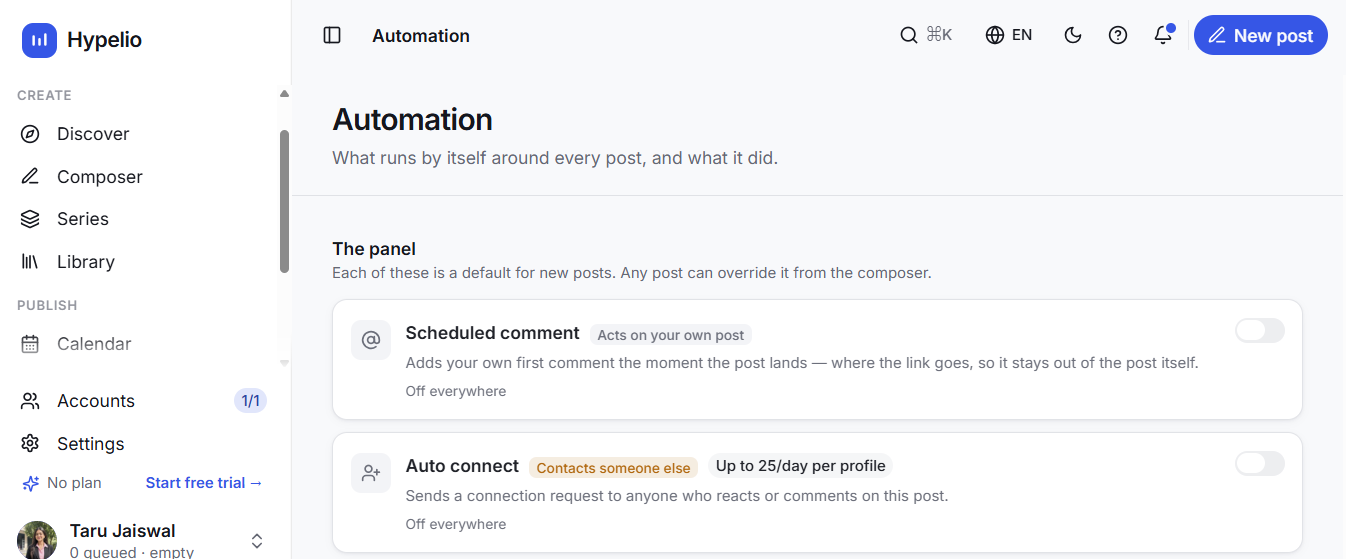
Audience-optimised scheduling: Posts go out at each account's specific peak-activity window, not a generic default time.
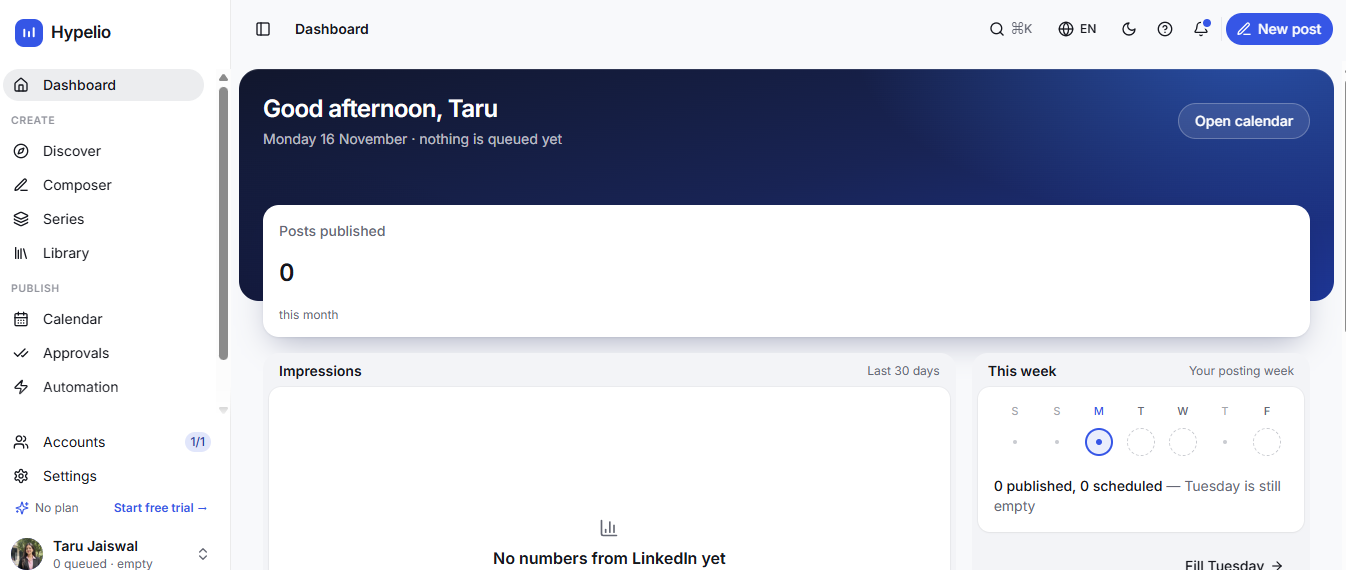
One-click reporting: Client-ready analytics dashboard that agencies can share directly.
The core argument for Hypelio and Hyperclapper working together: Hyperclapper handles the engagement trigger; Hypelio handles everything that makes the content worth triggering. Neither tool completes the stack alone.
How Hypelio Integrates With Hyperclapper: The Smarter Workflow Explained
How Hypelio Integrates With Hyperclapper
The end-to-end workflow, in practice, looks like this:
Voice capture (2 minutes): The author records a voice note in Hypelio's story bank — a client story, a professional opinion, a recent observation.
Draft generation (automated): Hypelio builds a draft using the author's verbatim phrases. The output reads like the author because it literally is the author's words.
Client approval (1 click): The draft is sent via a shareable link through Hypelio's client approval workflow. The client approves or comments — no password sharing, no email threads.
Optimised scheduling (automated): Hypelio schedules the post for the account's peak audience-activity window.
Pod engagement fires (Hyperclapper): At the moment of publication, Hyperclapper coordinates pod engagement — real LinkedIn users reacting and commenting within the first 30–60 minutes.
The timing dimension is what makes this combination meaningfully better than running Hyperclapper on a manually published post. A pattern observed across high-performing LinkedIn accounts is that engagement velocity in the first 30–60 minutes carries disproportionate algorithmic weight — posts that spike early get pushed into second and third-degree networks. Hypelio's audience-activity scheduling ensures the post lands in that window; Hyperclapper ensures the velocity spike follows immediately. Neither achieves that outcome reliably without the other.
The content that Hyperclapper amplifies reads as genuinely human because it was built from the author's own story bank phrases — reinforcing engagement rather than undermining it with generic AI output.
Why Use an Automation Layer on Top of Hyperclapper?
Hyperclapper answers one question: how do I get early engagement on a post that is already published? It does not answer: how do I consistently produce posts that are worth engaging with, get them approved without friction, and publish them at the right time across five or ten client accounts simultaneously?
That is the automation layer Hypelio provides. Without it, the operational overhead of running Hyperclapper properly across multiple accounts — consistent content, consistent timing, consistent approval — falls back on manual effort. That manual effort is exactly what compounds into 20+ hours per week for agencies. The Hypelio LinkedIn MCP integration makes this coordination systematic rather than ad hoc.
Is LinkedIn Pod Automation Safe in 2026? Risks, Detection Thresholds, and What Actually Flies Under the Radar
Is LinkedIn Pod Automation Safe in 2026?
This is the question practitioners actually want answered — and the one most tool guides avoid. Here is an honest breakdown.
LinkedIn's algorithm detection thresholds are well-documented for certain categories of automation:
High-risk (frequently detected and penalised): Mass connection request bots, automated InMail sequences sent at non-human speeds, fake profile engagement, scraping at volume.
Lower risk (far less enforced): Content scheduling, approval workflows, publishing cadence management. These mimic normal human publishing behaviour because they essentially are normal human publishing behaviour — just systematised.
Grey zone (Hyperclapper's territory): Pod engagement from real, active LinkedIn accounts. This is not fake engagement — real people are reacting and commenting. The risk is lower than bot-driven tactics, but the accounts participating should be genuine and the content genuinely relevant to them.
⚠️
Warning:Pod engagement on generic, low-quality content increases detection risk. If the content is clearly irrelevant to the people engaging with it, LinkedIn's spam signals activate faster. This is precisely why content quality — Hypelio's focus — is not optional in a pod strategy.
What Hypelio adds in terms of risk mitigation: authentic voice-sourced content, human-paced scheduling, and a client-approved approval trail all reduce the behavioural signals that trigger LinkedIn's spam detection. Bulk-scheduled generic posts without approval workflows look different to the algorithm — and to the readers who would otherwise flag them.
Common Mistakes to Avoid When Combining Automation Tools on LinkedIn
Firing pod engagement on generic AI content: Real engagement from real accounts on content that reads as clearly templated undermines credibility and can suppress reach rather than boost it.
Ignoring scheduling windows: Pod engagement at 11pm on a post published at 9am adds noise, not velocity. Timing the post and the pod together is the whole point.
Running too many accounts without separation: Multi-account management without proper workspace separation (as Hypelio provides) creates shared-IP signals that LinkedIn flags. See Hypelio's privacy policy for how account data is handled.
Skipping client approval: Publishing without sign-off creates compliance risk for agencies and reputational risk for clients. It also removes the human checkpoint that keeps content quality consistent.
Hypelio vs Manual LinkedIn Engagement: Does It Actually Save Time and Increase Reach?
Hypelio
Consider what manual LinkedIn management actually costs for a ghostwriter or agency handling five client accounts. Drafting takes time. Revisions take time. Approval chains via email take time. Scheduling at the right window requires checking each account's analytics. Reporting takes more time still. Done thoroughly, that stack easily exceeds 20 hours per week — and consistency is the first thing to collapse under that load.
According to Snovio's LinkedIn research (2026), professionals using LinkedIn automation tools report saving an average of 10 hours per week on manual effort while seeing measurable improvements in engagement outcomes. In practice, Hypelio compresses the most time-intensive steps:
Average engagement rate for personal LinkedIn profiles — 50% higher than company pages at 1.74%
According to Metricool's 2026 LinkedIn data, personal profiles achieve a 2.60% engagement rate compared to company pages at 1.74%. This means ghostwriters and founders who publish consistently through personal profiles — at the right time, with authentic content — have a structural engagement advantage. Hypelio is built around exactly that model. The combination of consistent publishing cadence and Hyperclapper's velocity spike is what converts that structural advantage into measurable reach.
Hypelio Pricing and Plans: Is It Worth It at Scale?
Hypelio pricing is structured per connected account and billed upfront. For agencies managing five or more LinkedIn profiles, this per-account model works out meaningfully cheaper than alternatives like Taplio or Supergrow, which charge flat monthly fees that do not scale efficiently with account volume. The more accounts under management, the stronger the economics. For a solo ghostwriter managing three to five clients, the cost is comparable to other tools — the differentiation comes from the story bank and approval workflow, which have no real equivalent in the alternatives. Hypelio's terms are covered in full at hypelio.com/terms-and-conditions.
Manage Every Client LinkedIn Profile From One Workspace
Voice-to-draft, one-click approvals, audience-optimised scheduling, and reporting — all without holding client passwords.
Frequently Asked Questions About Hypelio, Hyperclapper, and LinkedIn Automation
How does Hypelio make Hyperclapper more efficient for LinkedIn growth?
Hypelio ensures the content Hyperclapper amplifies is authentic, approved, and published at the optimal audience-activity window. This means pod engagement fires at the moment it carries maximum algorithmic weight — the first 30–60 minutes after publication — rather than at a random time on generic content that dilutes its effect.
What is the difference between Hypelio and Hyperclapper?
Hyperclapper coordinates pod engagement — real LinkedIn users reacting to your post to boost early visibility signals. Hypelio handles everything before that moment: capturing your voice, drafting authentic content, routing it through client approval, and scheduling it at the right time. They serve different parts of the stack and work best together.
Can I automate my Hyperclapper engagement pods using Hypelio?
Hypelio does not directly control Hyperclapper pods — the two tools operate independently. What Hypelio does is ensure that every post Hyperclapper amplifies is published at the audience-optimised window where pod engagement produces the strongest velocity signal. The integration is workflow-level, not API-level.
Is Hypelio worth using alongside Hyperclapper for LinkedIn?
For anyone managing more than two or three LinkedIn profiles — yes, clearly. Hyperclapper alone cannot manage content production, approvals, or scheduling at scale. Hypelio handles that operational layer, which means Hyperclapper's amplification effect is applied consistently to quality content rather than intermittently to whatever was manually published that day.
Is LinkedIn pod automation safe in 2026, and what does LinkedIn actually detect?
Pod engagement from real, active accounts sits in a lower-risk category than bot-driven fake engagement or mass outreach automation. LinkedIn's detection systems are most aggressive toward connection request bots, non-human-speed messaging, and fake profiles. Scheduling tools and content workflows face far lower enforcement. The key risk factor for pods is content quality — generic content engaged with by clearly unrelated accounts raises flags faster.
Does Hypelio work for agencies managing multiple client LinkedIn profiles?
Hypelio is specifically built for this use case. Each client account has its own workspace, voice profile, calendar, and analytics — managed under one agency login without storing client passwords. The client approval workflow and one-click reporting dashboard are designed for agency-to-client handoffs. Professionals at Google, Meta, Goldman Sachs, and Accenture use the platform in this way.
✓ The Hypelio + Hyperclapper Launch Checklist
☐Set up each client profile as a separate Hypelio workspace — distinct voice, calendar, and analytics per account.
☐Record at least three voice notes per client to populate the story bank before drafting begins.
☐Activate the client approval workflow — every draft goes via link before scheduling.
☐Check each account's audience-activity data in Hypelio and set scheduling windows accordingly.
☐Add the client's LinkedIn profile to your Hyperclapper pod so engagement fires at publication.
☐Run the first week manually alongside automation to verify timing, voice accuracy, and engagement quality before scaling.
What consistently separates LinkedIn accounts that compound reach over time from those that plateau — regardless of which tools they use — is not the engagement pod or the scheduling tool in isolation. It is whether the content is genuinely worth amplifying in the first place. Automation layers that sit on top of authentic, human-paced content production scale something real. Those that sit on top of generic output simply scale noise faster.
Written by the team behind Hypelio. We publish what we have actually seen work across the accounts we help run — and say so plainly when something did not.
Writing the post is the easy part
The hard part is the next one, and the one after that, still sounding like you. Hypelio drafts in your voice, keeps the queue full, and works the same whether you run one account or twenty.