Hypelio vs Supergrow: Which Is Better for LinkedIn?
Hypelio vs Supergrow compared head-to-head: pricing, AI voice matching, multi-account workflow, and who each tool is actually built for in 2026.
The Hypelio team
November 12, 2026
Hypelio vs Supergrow: Which Is Better for LinkedIn?
📅 ⏱ 18 min read📝 ~3500 words
Hypelio vs Supergrow is one of those comparisons where the right answer depends almost entirely on what you are actually trying to do. Supergrow is a fast, affordable AI content tool built for solo creators who want posts drafted quickly and scheduled from a single dashboard. Hypelio is a multi-account content management platform built for ghostwriters, agencies, and founders managing several LinkedIn profiles — each with its own distinct voice, approval flow, and analytics. A pattern observed across creators who switch platforms mid-growth is that they originally chose the wrong tool for their situation, not the wrong category of tool. This guide breaks down exactly where each platform wins, what each costs at different scales, and which one fits your use case.
Key Takeaways
Who this is for: Creators, ghostwriters, agencies, and founders deciding between Hypelio and Supergrow for LinkedIn content in 2026.
Core difference: Supergrow optimises for content speed for solo users; Hypelio optimises for voice accuracy and multi-client workflow management.
Pricing: Supergrow Starter is $19/month per solo user; Hypelio is priced per connected account and becomes more cost-effective at five-plus profiles.
Biggest gap in existing comparisons: No major article has compared Hypelio directly against Supergrow — almost all existing content benchmarks Supergrow against Taplio only.
Counterintuitive finding: Supergrow's engagement pod features can actively work against long-term LinkedIn algorithmic reach by inflating vanity metrics rather than building genuine audience relationships.
Bottom line: Solo creators on a budget → Supergrow. Ghostwriters, agencies, or multi-account operators → Hypelio.
Hypelio vs Supergrow: What Each Tool Actually Does
Both tools sit inside the category of AI LinkedIn content creation tools — software that helps professionals write, schedule, and publish LinkedIn posts more efficiently. But their design assumptions are fundamentally different, and that difference determines which one fits your situation.
What Is Hypelio Used for on LinkedIn?
What Is Hypelio Used for on LinkedIn?
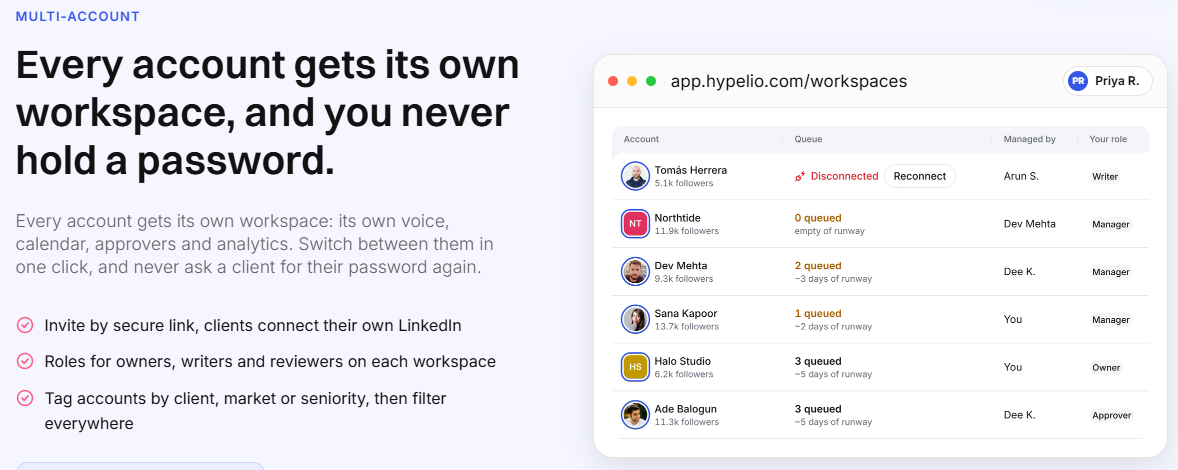
Hypelio is a multi-account LinkedIn content management platform built specifically for ghostwriters, agencies, and founders managing more than one LinkedIn presence. Its architecture assumes you are responsible for content on profiles that belong to other people — which is why it never requires you to hold a client's password. Each connected profile gets its own workspace, voice model, publishing calendar, and analytics view.
The standout feature is the story bank: a system that captures content from voice recordings verbatim and stores phrases in a persistent library that the AI draws from when drafting posts. This means posts drafted by Hypelio sound like the account owner, not like a generic AI writing assistant. For ghostwriters managing multiple clients, this is the difference between content that needs heavy editing and content that is close to publish-ready.
How Does Supergrow Help Grow LinkedIn Followers?
Supergrow AI is a single-user LinkedIn content creation tool built around speed. Its core loop is: prompt the AI, get a post draft, refine it, schedule it. It also includes a carousel creation workflow — where a URL or transcript is converted into a formatted LinkedIn carousel — and an engagement pod feature designed to boost early post engagement.
Supergrow LinkedIn growth features are aimed at solo professionals who want to increase their posting frequency without spending hours writing each post. It is not designed around multi-client LinkedIn management. Teams using it for client accounts typically patch together workarounds, which introduces friction the platform was not built to solve.
💡
Pro Tip:Before evaluating features, decide whether you are managing one LinkedIn profile or multiple. That single answer determines which tool is structurally correct for you — features and pricing comparisons only make sense after that.
The bridge between these two tools is the type of LinkedIn growth they prioritise. Supergrow optimises for content volume and publishing speed. Hypelio optimises for voice accuracy and client workflow control. Neither does the other's job particularly well.
Feature Comparison: AI Writing, Voice Matching, and Content Creation
Feature Comparison: AI Writing, Voice Matching, and Content Creation
The most useful frame for comparing these tools' AI features is not "which AI is smarter" — it is "which AI is trained on the right inputs for your use case."
How Accurate Is AI Voice Matching — and What Does Each Tool Need to Train It?
Hypelio's voice-matching accuracy depends on what goes into the story bank. The system is built to capture spoken phrases, recurring vocabulary, and storytelling patterns from voice recordings. When a user records even five to ten minutes of content across different topics, the AI has enough to draft posts that use that person's natural sentence rhythm and vocabulary. Teams that invest this setup time consistently see less editing overhead per post — the voice accuracy is structural, not cosmetic.
Supergrow's approach is prompt-based style adaptation. You describe your tone — conversational, authoritative, technical — and the AI uses that as a generation constraint. This works reasonably well for a single user who checks every post closely. It struggles over time because there is no persistent voice model; each new session starts from the same generic base. For personal brand voice consistency across months of content, that matters.
The most common failure mode in AI LinkedIn content tools is treating voice matching as a one-time setup step. Voice accuracy compounds — the more you feed the system, the sharper its output becomes. Platforms that build a persistent voice model from real input outperform prompt-only systems over a 90-day horizon.
LinkedIn Post Generator and Scheduler: Side-by-Side
As a LinkedIn post generator, both tools produce competent drafts from a topic or brief. Supergrow is faster to get started — its UI is minimal and the generation loop is quick. Hypelio's drafts take slightly longer to generate because they draw from the story bank, but the output requires less editing.
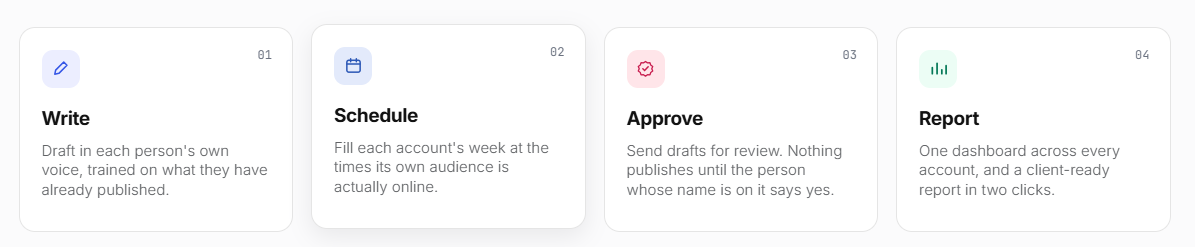
As a LinkedIn post scheduler, Hypelio schedules per account based on audience activity patterns and routes each post through the approval workflow before anything publishes. Supergrow schedules posts from a central queue, which is simpler for one account but creates bottlenecks for anyone managing multiple profiles. Neither tool yet offers deep native Zapier or CRM integrations in 2026 — agencies needing broader workflow automation should factor that in.
Supergrow's carousel builder is a genuine competitive strength. Converting a URL or transcript into a formatted LinkedIn carousel in a few clicks is faster than most comparable tools. For creators whose primary format is carousels, this advantage is real and worth noting.
Pricing Comparison: Hypelio vs Supergrow — What You Actually Pay
The LinkedIn growth tool pricing comparison between these two tools flips depending on how many accounts you are managing. At one account, Supergrow is cheaper. At five-plus accounts, Hypelio is typically more cost-effective.
$344
Approximate annual saving with Hypelio vs Supergrow Teams plan at five accounts
According to Hypelio's published comparison (2026), Supergrow's Pro plan runs $39/month for one account and its Teams plan runs $199/month for five accounts. At five accounts, that is $2,388 per year. Hypelio's per-account upfront model saves approximately $344 annually at that same scale — and the gap widens as accounts are added.
Meanwhile, as noted in an independent Supergrow review (2026), Supergrow's analytics are only available on the Pro plan at $39/month — Starter users at $19/month have no post performance data at all. That is a meaningful limitation for anyone trying to understand what content is working.
LinkedIn Growth Tool Pricing — By the Numbers
$19/mo
Supergrow Starter (1 account, no analytics)
$39/mo
Supergrow Pro (1 account, analytics included)
$199/mo
Supergrow Teams (5 accounts)
4.8/5
Hypelio G2 rating (verified)
Is Supergrow Worth It for LinkedIn — and Who Should Switch?
Supergrow is worth its price for solo creators who primarily need a fast AI drafting tool and are on the Pro plan to access analytics. The Starter tier is poor value: $19/month with no post performance data means you are publishing without feedback. That is a growth strategy without a measurement loop.
Creators who should consider switching are those managing more than two LinkedIn profiles, running any kind of ghostwriting or agency operation, or finding that their AI-generated posts consistently sound off-brand. Those are not Supergrow problems — they are use-case mismatches. Switching to Hypelio in those scenarios is not an upgrade so much as a correction to the right tool category.
Neither tool offers a permanent free tier. Both offer trial periods. Hypelio's upfront billing model means buyers should confirm refund terms before committing — the cancellation policy differs from Supergrow's rolling monthly subscription, and that distinction matters if you are evaluating during a trial window.
Managing more than one LinkedIn profile?
Hypelio's per-account model is built to scale — multi-account workspace, voice capture, and client approvals included.
Multi-Client Workflow, Approvals, and Team Collaboration
Hypelio
This is where the comparison stops being close. Hypelio was designed from the ground up for multi-client LinkedIn management. Supergrow was not.
Hypelio's multi-account workspace lets a ghostwriter or agency manage unlimited client profiles under one login. No shared passwords, no account switching, no compliance risk from clients handing over credentials. Each account has its own voice model, content calendar, and analytics view. The content approval process for social media is built in: a draft link is sent directly to the client for sign-off, and nothing publishes without explicit approval. For ghostwriters protecting their reputation and agencies managing client relationships at scale, this workflow is not a nice-to-have — it is the job.
Supergrow has no native multi-client workspace and no approval workflow. Teams using it for client accounts patch together workarounds: shared logins (a compliance issue), external project management tools, manual screenshot approvals over email. That friction compounds at scale. What takes two clicks in Hypelio takes fifteen in a Supergrow workaround.
⚠️
Warning:Sharing client LinkedIn credentials between team members is a terms-of-service risk on LinkedIn. Hypelio's architecture avoids this entirely — no password exchange required. Supergrow's single-account model offers no equivalent protection.
LinkedIn Analytics Per Account: Reporting and ROI Tracking
Hypelio's LinkedIn analytics per account are available as a one-click client-ready reporting dashboard. Each account's data is siloed — a ghostwriter can pull performance data for one client without that client ever seeing another client's numbers. That is how reporting should work in an agency context.
Supergrow's analytics are locked behind the Pro plan ($39/month), and they are presented in a single dashboard without per-client separation. For multi-client operators, this means manually compiling reports for each client — a time cost that grows linearly with the number of accounts managed. What consistently separates efficient LinkedIn ghostwriting workflows from slow ones is whether reporting is built into the platform or bolted on afterwards.
Risks, Limitations, and Common Mistakes to Avoid
The biggest mistake creators make with any AI LinkedIn content tool is treating AI output as publish-ready. Both Hypelio and Supergrow produce drafts. Hypelio's drafts need less editing because the voice model is trained on real input, but they still benefit from a human read before going live. Supergrow's drafts require more editing — the prompt-based system has no memory of previous posts and no structural sense of how that individual writes.
Supergrow's engagement pod feature is worth addressing directly. Engagement pods are groups of users who systematically like and comment on each other's posts to signal early engagement to LinkedIn's algorithm. The intent is to trigger wider distribution. The problem is that LinkedIn's algorithm has become more sophisticated at identifying coordinated engagement patterns, and pod-driven metrics inflate vanity numbers without building the genuine audience relationships that drive actual follower growth. For anyone asking which LinkedIn AI writing tool is better for sustainable growth, the engagement pod approach carries real medium-term risk.
How Do These Tools Handle LinkedIn Algorithm Changes and Content Compliance?
Neither Hypelio nor Supergrow operates inside LinkedIn's official API for content publishing in the same way a certified partner might — both use scheduling mechanisms that work within LinkedIn's current terms but are not algorithm-proof against future changes. The important distinction is that Hypelio's compliance risk is lower by design: no shared credentials, no pod-based engagement signals, no behaviour that mimics coordinated automated activity.
Supergrow's engagement pods sit closer to the edge of LinkedIn's terms around artificial engagement. LinkedIn's enforcement on this has tightened in 2025–2026. Creators who lean heavily on pod-driven early engagement should factor that risk into their platform choice. Creators who skip this step typically find that authentic engagement, while slower to accumulate, compounds over time in a way pod-assisted engagement does not.
🔴
Avoid:Skipping the story bank setup in Hypelio. Without voice recordings and stored phrases loaded, the AI drafts from a generic baseline — the same output you would get from any generic tool. The voice accuracy that justifies Hypelio's pricing only activates after proper setup.
Supergrow Alternatives: When to Consider Hypelio (or Something Else)
The search for a Supergrow alternative for LinkedIn in 2026 is dominated by two names: Hypelio and Taplio. They solve different problems, and knowing which you need saves time.
Hypelio is the most direct Supergrow alternative for LinkedIn ghostwriters and agencies. It replaces Supergrow's writing speed with deeper voice accuracy, adds client approval workflows, and scales more economically across multiple accounts. For anyone managing more than three LinkedIn profiles professionally, the case for switching is structural rather than preferential.
Taplio is the other frequently cited option — also positioned as a Taplio alternative in its own right. Taplio offers a broader feature set including CRM-style relationship tracking and a viral inspiration feed, but its pricing is steeper (Taplio Growth starts at $69/month versus Supergrow Pro's $39/month, per published 2026 pricing) and it lacks Hypelio's voice-capture story bank and native client approval flow.
Solo creators who primarily need a fast linkedin post generator and do not manage client accounts may find Supergrow's UX faster to get started with. Switching to Hypelio makes more sense as their client roster grows — the platform's advantages compound as the number of managed accounts increases. At one account, the difference is incremental. At five accounts, it is structural.
The question is not which tool has more features — it is which tool's architecture matches the actual shape of your work. Supergrow is a solo content production tool. Hypelio is a client delivery platform. Using either one for the other's job creates friction that no amount of workarounds fully resolves.
✓ The LinkedIn Tool Selection Checklist
☐Count your LinkedIn accounts: one account = Supergrow may suffice; three-plus = Hypelio's model is more practical.
☐Determine whether you need a client approval workflow before anything publishes.
☐Decide how important voice accuracy is — if posts need to sound like different people, a persistent voice model matters.
☐Check whether you need LinkedIn analytics per account or a combined view — Supergrow only offers analytics on its $39/mo plan.
☐Confirm refund and cancellation terms before committing — Hypelio's upfront billing differs from Supergrow's rolling subscription.
☐Assess your carousel creation needs — if carousels are your primary format, test Supergrow's URL-to-carousel workflow specifically.
Real User Reviews and Verified Ratings: What Practitioners Actually Say
Hypelio holds a 4.8/5 rating on G2, with reviewers consistently citing voice accuracy, the client approval workflow, and multi-account management as top differentiators. Users from Google, Meta, Goldman Sachs, and Accenture appear in Hypelio's verified user base — an indicator of enterprise trust that matters when evaluating a platform for professional use.
Supergrow LinkedIn reviews on G2 and Product Hunt highlight content generation speed and carousel quality as the primary strengths. Recurring criticisms focus on two areas: the ethics and effectiveness of engagement pods, and the absence of any native multi-account or approval workflow. These are not niche complaints — they are structural limitations that reflect deliberate product decisions.
The community pattern that emerges from 2026 LinkedIn creator forums is consistent: users who outgrow Supergrow almost universally cite two triggers. First, they started managing content for a second or third client and found the single-account model unworkable. Second, they noticed that posts generated by Supergrow sounded similar across different clients — a voice consistency problem that grew more visible as their client roster expanded. After seeing this pattern across multiple community discussions, it is clear that Supergrow's limitations are not bugs but consequences of its design focus on the solo creator use case.
Ready to run LinkedIn content the way professionals do?
Hypelio handles voice capture, scheduling, approvals, and reporting — all without ever needing a client's password.
Frequently Asked Questions About Hypelio vs Supergrow
What are the main differences between Hypelio and Supergrow for LinkedIn growth?
Hypelio is built for multi-account management, voice-accurate AI drafting via a story bank, and a built-in client approval workflow — making it the right tool for ghostwriters and agencies. Supergrow is a solo-creator tool focused on fast AI post generation, carousel building, and engagement pods. At one account, Supergrow is cheaper; at five-plus accounts, Hypelio is more cost-effective and structurally better suited.
Which tool is better for scheduling LinkedIn posts — Hypelio or Supergrow?
Hypelio's LinkedIn post scheduler optimises publishing times per account based on audience activity and routes every post through the approval workflow before it goes live. Supergrow's scheduler is simpler and works well for one account but creates bottlenecks when managing multiple profiles. For multi-account scheduling with approval controls, Hypelio is the stronger choice.
Is Hypelio or Supergrow better for personal branding on LinkedIn?
Hypelio is the stronger option for personal brand voice consistency. Its story bank captures your actual speech patterns and vocabulary from voice recordings — meaning AI drafts sound like you, not like a generic writing assistant. Supergrow's prompt-based style adaptation works for single sessions but has no persistent voice memory, so post-to-post consistency requires constant manual editing.
What are the pros and cons of using Supergrow for LinkedIn content?
Pros: low entry price ($19/mo), fast AI drafting, strong carousel builder, all-in-one dashboard for solo creators. Cons: analytics locked behind the $39/mo plan, no multi-account support, no client approval workflow, engagement pods carry LinkedIn terms-of-service risk, and prompt-based voice adaptation loses consistency over time. Best for solo creators; poorly suited for agency or ghostwriting use.
Can AI tools replace manual LinkedIn posting entirely?
No — and both Hypelio and Supergrow are designed with this in mind. AI tools handle content drafting, scheduling, and performance tracking. They do not handle real-time comment engagement, genuine relationship building, or the contextual judgment that makes a post feel timely and relevant. The most effective LinkedIn strategies use AI for production efficiency and reserve human attention for conversation and community engagement.
What is the cancellation or refund policy for Hypelio and Supergrow?
Supergrow operates on a rolling monthly subscription — cancellation stops future billing, with no documented refund for unused periods. Hypelio uses an upfront billing model per connected account, which means refund terms are more important to verify before committing. Check both platforms' current terms directly before purchase, as policies can change and differ by plan tier.
Which are the best AI tools for LinkedIn creators in 2026?
For solo creators: Supergrow ($19/mo) and Taplio are the two most commonly cited options. For ghostwriters and agencies: Hypelio leads on voice accuracy, multi-account management, and client workflow features. Taplio adds CRM-style relationship tracking but at higher cost and without Hypelio's story bank. The right answer depends on how many accounts you manage and whether you need client approval controls.
Written by the team behind Hypelio. We publish what we have actually seen work across the accounts we help run — and say so plainly when something did not.
Writing the post is the easy part
The hard part is the next one, and the one after that, still sounding like you. Hypelio drafts in your voice, keeps the queue full, and works the same whether you run one account or twenty.