Hypelio vs Taplio: Which one Is Better for LinkedIn?
Hypelio vs Taplio compared honestly: pricing, AI writing, multi-account management, and agency workflows. Find out which LinkedIn tool is right for your needs.
The Hypelio team
November 10, 2026
Hypelio vs Taplio: Which one Is Better for LinkedIn?
📅 ⏱ 16 min read📝 ~3200 words
Hypelio vs Taplio is one of the most consequential tool decisions a LinkedIn content professional makes — and picking the wrong one costs more than money. A pattern observed consistently across agency and ghostwriting operations is that people choose based on marketing pages rather than workflow fit, then spend months working around the tool's limitations. Taplio is built for a solo creator who wants one polished instrument for their own brand. Hypelio is built for anyone managing multiple LinkedIn voices, where post authenticity and client sign-off are non-negotiable. If you're one person posting for yourself, that distinction barely matters. If you're running accounts for others, it's everything.
Key Takeaways
Who this is for: Ghostwriters, agencies, founders, and solo creators deciding between Hypelio and Taplio for LinkedIn content management.
Taplio suits individual creators — strong AI drafts, in-feed engagement features, and clean analytics for one account.
Hypelio suits agencies and ghostwriters — multi-account workspaces, voice-preserving story bank, and a formal client approval workflow.
Pricing reality: According to Contentin.io (2026), Taplio's $39 plan includes zero AI credits, making the real entry point $69/month — a recurring frustration in community forums.
Most counterintuitive finding: Hypelio is often cheaper than Taplio for teams managing five or more accounts, despite feeling like the more "enterprise" product.
Neither tool is universally better — the right choice depends entirely on how many LinkedIn voices you manage.
What Is Taplio and What Is Hypelio? (Quick Overview)
What Is Taplio and What Is Hypelio? (Quick Overview)
Taplio is an AI-powered LinkedIn scheduling tool and growth platform built primarily for individual creators and solopreneurs. It generates post ideas, schedules content, tracks engagement, and surfaces relationship-building opportunities via a lightweight CRM dashboard. Hypelio is a LinkedIn content management platform engineered specifically for agencies, ghostwriters, and founders managing multiple LinkedIn voices — its architecture ensures every post published under a client's name sounds like that person, not like a generic AI output.
The fundamental design difference is not about features. It's about who is operating the tool. Taplio assumes one person, one brand, one LinkedIn profile. Hypelio assumes one operator, multiple clients, multiple voices — all running in parallel without password sharing or blurred identity. Both target the same surface-level outcome: more consistent, higher-quality LinkedIn content. But they serve fundamentally different workflows, and understanding that split is the fastest way to pick the right one.
What Taplio Does (Core Feature Set)
Taplio's core feature set is built around four things:
AI post generation from topic prompts and historical content style
Content repurposing from tweets, blog posts, or URLs into LinkedIn drafts
Scheduling with post-time recommendations based on past performance
A lightweight CRM for tracking who's engaging and following up on conversations
Analytics covering impressions, engagement rate, and follower growth — benchmarked against a database of over 200,000 posts, according to AuthoredUp's 2026 Taplio review
A Taplio Chrome extension for in-feed engagement — liking, commenting, and tracking connections directly from the LinkedIn feed
What Taplio does not do well: manage multiple accounts efficiently, preserve a specific person's voice across AI drafts, or provide a client-facing deliverable after a content cycle.
What Hypelio Does (Core Feature Set)
Hypelio's core feature set addresses a different set of problems:
Multi-account workspaces — unlimited LinkedIn profiles, one login, zero password sharing
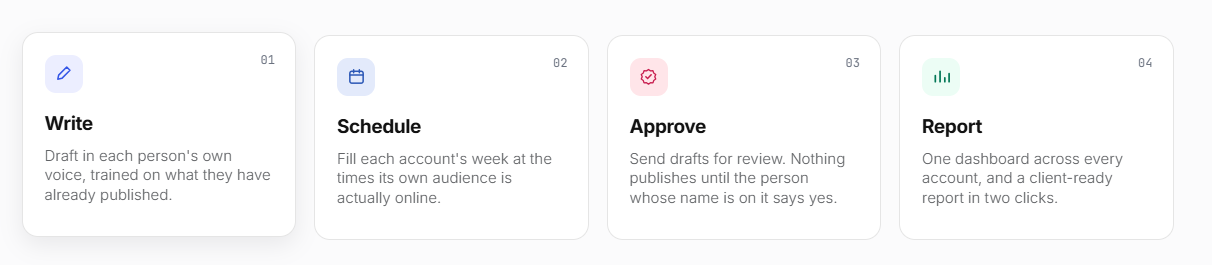
Story bank — captures voice memos verbatim and uses those phrases as AI training material, so drafts sound like the actual author
Client approval workflow — shareable links where clients review and approve drafts before anything publishes
Per-account scheduling optimised to each account's audience activity patterns
One-click client-ready reporting, designed to be sent as a deliverable, not just consumed internally
Hypelio is rated 4.8/5 on G2 and used by professionals at organisations including Google, Meta, Goldman Sachs, and Accenture — a signal that the multi-account, multi-voice architecture holds up under enterprise-level scrutiny.
AI Writing and Voice Preservation: Where They Diverge Most
Hypelio
The most common failure mode in LinkedIn ghostwriting is producing AI drafts that sound like they came from the same template — regardless of which client they're for. Taplio does use AI for LinkedIn posts. It generates drafts based on a topic prompt and analyses your historical content style to match tone. For a solo creator who posts consistently, this works reasonably well. The AI is capable. But the outputs require meaningful editing to pass as genuinely personal, particularly for clients with distinctive voices or niche audiences.
💡
Pro Tip:When evaluating any LinkedIn AI writing tool, don't test it on a sample prompt — test it on a real client's voice. Demo posts are cherry-picked for quality; story-bank-anchored drafts are reproducible at scale. That's the difference that matters in a live ghostwriting workflow.
LinkedIn Post Generator: Taplio vs Hypelio Output Quality
Hypelio's story bank is the differentiator in this comparison. The story bank is a voice-capture system that records the actual author speaking — anecdotes, opinions, specific phrases — and uses that verbatim material as the input layer for AI-generated drafts. The result is a LinkedIn post generator that produces content built from the person's own words, not from a model's approximation of what they might say.
For ghostwriters managing five to fifteen client accounts, AI voice preservation is not a nice-to-have — it's the entire value proposition. A tool that blends voices across clients is a liability. A client whose post sounds like every other AI-generated LinkedIn post is a client who cancels the retainer. Hypelio's architecture prevents voice blending by design; Taplio's does not address this problem at all, because it was never designed for multi-client operation.
The right question isn't "which tool produces better AI posts?" It's "which tool produces posts that sound like the right person?" Those are entirely different problems requiring entirely different architectures.
Multi-Client Management, Collaboration, and Agency Workflows
Taplio is built for a single LinkedIn account per subscription. Managing multiple clients means separate logins, separate subscriptions, and manual context-switching — an operational overhead that scales badly. What separates Hypelio from every Taplio alternative in this category is that multi-account management is not a bolt-on feature; it's the foundational design decision.
LinkedIn Ghostwriting Workflow: Which Tool Actually Supports It
A LinkedIn ghostwriting workflow has three structural requirements that most scheduling tools ignore:
Account isolation — each client's voice, calendar, and analytics must be completely separate
Credential security — no tool should ever require the client's LinkedIn password
Client sign-off — there must be a formal approval step before anything publishes under a client's name
Hypelio addresses all three. Its multi-account workspace handles account isolation and credential security natively. The client content approval process — shareable draft links where clients review and approve or reject with comments before publishing — directly removes the biggest professional liability in ghostwriting: posting content the client hasn't seen.
Taplio has no meaningful multi-user or client handoff functionality as of 2026. Teams that try to run a ghostwriting operation through Taplio typically end up building manual workarounds in Notion or Google Docs — which defeats the purpose of paying for a LinkedIn tool.
⚠️
Warning:Running multi-client account management through a single-account tool like Taplio means sharing credentials or building external approval processes manually. Either approach increases operational risk — a missed approval or a credential breach can end a client relationship permanently.
Managing LinkedIn for more than one person?
Hypelio's multi-account workspace handles isolated calendars, voice profiles, and client approvals — all under one login, without ever touching client passwords.
LinkedIn Scheduling, Analytics, and Integration Ecosystem
Both tools offer a LinkedIn post scheduler, but the scheduling logic differs in a meaningful way. Taplio recommends post times based on historical engagement data from your own account. Hypelio optimises publish times per individual account's audience activity — a material difference when managing accounts across different industries, job functions, or time zones. A finance executive's audience peaks at different times than a startup founder's; treating them identically produces worse results for both.
Taplio Chrome Extension and In-Feed Engagement Features
Taplio's Taplio Chrome extension is one of its most distinctive features — it embeds directly into the LinkedIn feed, surfacing engagement opportunities and tracking relationship conversations without leaving the platform. For a solo creator who treats LinkedIn as a relationship-building channel rather than just a publishing channel, this is genuinely useful. The extension supports commenting, tracking warm leads, and flagging contacts to follow up with — a CRM-lite layer built into the browsing experience.
Hypelio does not replicate this in-feed engagement layer. Its focus is on the content production and approval pipeline, not on engagement automation. Teams that use Hypelio and want in-feed engagement tooling typically handle that separately — either manually or via LinkedIn's own notifications.
On LinkedIn analytics tools: Taplio's analytics dashboard is well-designed for individual use, with benchmark comparisons against its database of 200,000+ posts. Hypelio's reporting is built differently — the one-click client-ready reporting dashboard produces a deliverable you send to a client, not just a screen you look at yourself. Same underlying data layer; fundamentally different purpose. For a LinkedIn analytics tool that serves an agency operation, Hypelio's framing is the more practical one.
On integrations: Taplio connects with Zapier, enabling lightweight CRM and notification workflows. Hypelio's integration ecosystem is more focused — built to slot into agency operations rather than a broad third-party app sprawl. Neither tool has a deep integration ecosystem comparable to full marketing platforms; both are focused tools, not hubs.
Pricing Comparison: Taplio vs Hypelio (And the Real Cost at Scale)
$69/mo
Taplio's real minimum price once AI credits are included — not the $39 advertised on the pricing page
According to Contentin.io's 2026 comparison of Taplio alternatives, Taplio's $39 plan includes zero AI credits — making the functional entry point $69/month for anyone who actually wants to use the AI features. This is the number-one pain point surfaced in community forums and is why so many users are searching for Taplio alternatives for LinkedIn in the first place. In practice, you're paying for the AI, not just the scheduling layer, so the $39 tier is rarely a meaningful option.
Hypelio pricing and plans operate on a per-connected-account model, billed upfront. At scale — five or more client accounts — the per-account cost drops significantly, making Hypelio structurally cheaper for agencies than buying five separate Taplio subscriptions. For a ghostwriting operation running ten client accounts, the difference is not marginal; it's the difference between a tool that fits your margin and one that erodes it.
Which LinkedIn Tool Is Best for Solopreneurs vs Agencies
Teams that use Hypelio consistently find that the per-account pricing model rewards growth — the more accounts you add, the more cost-effective the platform becomes. Taplio's model rewards individual depth; Hypelio's model rewards operational scale.
Solopreneur posting for their own brand: Taplio's $69/month gives you a complete, polished tool designed exactly for this use case — AI drafts, scheduling, analytics, and in-feed engagement in one place.
Agency or ghostwriter managing 3+ accounts: Hypelio's upfront per-account pricing plus multi-workspace architecture makes it both cheaper to run and operationally more appropriate.
Founder who outsources LinkedIn to a ghostwriter: Hypelio wins here — the client approval workflow and voice preservation mean the ghostwriter produces content that sounds like you, and you approve it before it goes live.
One important clarification on cancellation risk: with Taplio, cancelling mid-cycle on an annual plan typically means losing access immediately with no prorated refund — verify the current policy before committing. With Hypelio's upfront model, confirm what happens to scheduled content on account disconnection before onboarding clients. These are operational details that matter at the moment you need them, not when you're signing up.
🔴
Avoid:Evaluating LinkedIn personal branding automation tools on headline price alone. Taplio's $39 tier looks competitive until you realise it has no AI credits. Always calculate the cost at the tier you'll actually use — then multiply by the number of accounts you manage.
See what Hypelio actually costs for your account count
Per-account pricing makes the numbers clear — no hidden tiers, no AI credit caps at the entry level.
Honest Verdict: When Hypelio Wins, When Taplio Wins, and Taplio Alternatives Worth Knowing
After seeing this split across dozens of LinkedIn content operations, the pattern is consistent: the tool that wins is never the one with the longest feature list. It's the one whose architecture matches how you actually work.
Quick Answer: Best LinkedIn Tool for Your Goal
Best for agencies and ghostwriters → Hypelio — multi-account isolation, voice preservation, and client approval built in by design
Best for solo creators building their own brand → Taplio — polished single-account tool with in-feed engagement and solid AI drafting
Best for founders outsourcing their LinkedIn → Hypelio — your ghostwriter works in the platform; you approve before anything publishes
Best for content repurposing from other channels → Taplio — tweet-to-post and blog-to-post repurposing is well-executed
Best LinkedIn scheduling ROI at scale → Hypelio — per-account pricing becomes significantly cheaper at five or more accounts
LinkedIn Content Creation Tools Comparison: Key Risks and Limitations
Taplio alternatives worth comparing in 2026 include:
Supergrow — strong content repurposing angle, well-suited to creators who publish heavily from other platforms
Hypefury — built around Twitter/X crossposting with LinkedIn as a secondary channel; best for creators active across both networks
AuthoredUp — a focused post editor and analytics layer, without the full scheduling and AI suite; pairs well as a complement rather than a replacement
Shield Analytics — a pure analytics layer for creators who want deeper data without switching their entire workflow
None of the alternatives replicate Hypelio's combination of story bank and client approval workflow. For LinkedIn content creation tools comparison purposes, that pairing is unique — and it's the specific combination that matters for managed LinkedIn services.
The key risk with any LinkedIn scheduling ROI calculation: the tool you pick shapes what kind of service you can offer. Taplio caps you at one-account-at-a-time efficiency. Hypelio multiplies your capacity without multiplying your operational overhead. For ghostwriters and agencies, that's not a feature difference — it's a business model difference. The best time to post on LinkedIn matters far less than whether your tool can execute that timing across all your client accounts simultaneously.
Creators who choose a single-account tool and then try to scale into multi-client work typically find themselves rebuilding their entire workflow from scratch 6-12 months later — not because the tool got worse, but because they outgrew a constraint that was always there.
✓ The LinkedIn Tool Selection Checklist
☐Count how many LinkedIn accounts you're managing — not planning to manage, actually managing today
☐Test AI output on a real client brief, not a demo prompt — does it sound like them?
☐Confirm whether the tool requires client LinkedIn passwords for connection (Hypelio doesn't; some alternatives do)
☐Check whether a formal client approval step exists — or whether you're approving in a separate tool
☐Calculate total monthly cost at your actual account count — not headline tier price
☐Verify cancellation and refund policy before committing to an annual plan
☐Confirm what happens to scheduled posts if you disconnect an account mid-cycle
Frequently Asked Questions About Hypelio vs Taplio
What are the main differences between Hypelio and Taplio for LinkedIn content creation?
Hypelio is designed for multi-account workflows — agencies, ghostwriters, and founders managing multiple LinkedIn voices. Taplio is designed for individual creators managing their own brand. The core differences are: Hypelio has a story bank for voice preservation, a client approval workflow, and multi-account isolation. Taplio has in-feed engagement tools and a single-account AI drafting experience.
Which tool is better for growing a LinkedIn audience — Hypelio or Taplio?
Taplio is better for growing your own LinkedIn audience as an individual — its in-feed engagement features, relationship CRM, and consistent AI drafting are optimised for personal brand growth. Hypelio is better when you're growing audiences for multiple clients simultaneously, where voice consistency and operational scale matter more than any single engagement feature.
Can Hypelio replace Taplio for LinkedIn scheduling and analytics?
Yes, for most scheduling and analytics use cases. Hypelio includes per-account LinkedIn scheduling optimised to audience activity, plus client-ready reporting. It does not replicate Taplio's Chrome extension or in-feed engagement layer — if those features are central to your workflow, that's a genuine gap to account for.
Is Taplio worth the price compared to cheaper LinkedIn tools?
For a solo creator who posts consistently and uses the full AI, analytics, and engagement suite, Taplio at $69/month can deliver value. For anyone managing multiple accounts, the per-seat cost compounds quickly. According to Contentin.io (2026), the $39 entry plan includes no AI credits — so the real cost question only starts at $69. At that price point, Hypelio is a materially cheaper option at scale.
How much does Taplio cost per month in 2026?
Taplio's pricing starts at $39/month but that plan includes zero AI credits, making it limited in practice. The functional entry point — the tier most users actually need — is $69/month. Advanced plans with richer analytics and more AI output sit above that. Always calculate cost based on the tier you'll actually use, not the lowest advertised figure.
How do Hypelio and Taplio handle LinkedIn algorithm changes and content compliance?
Neither tool makes real-time algorithmic adjustments automatically — that's not how LinkedIn scheduling tools work. Both rely on best-practice scheduling and content guidelines. Hypelio's client approval workflow adds a human review step before anything publishes, which provides a natural compliance checkpoint. Taplio leaves compliance to the individual user. Neither tool is "approved" by LinkedIn — both operate within standard API parameters.
How do Hypelio and Taplio perform for non-English LinkedIn content?
Taplio's AI drafting is primarily optimised for English-language content — non-English outputs tend to require more editing and may not capture natural phrasing as reliably. Hypelio's story bank approach is language-agnostic by design: because drafts are anchored in the author's own recorded phrases, the language fidelity depends on the voice input, not on the model's training data for that language.
Written by the team behind Hypelio. We publish what we have actually seen work across the accounts we help run — and say so plainly when something did not.
Writing the post is the easy part
The hard part is the next one, and the one after that, still sounding like you. Hypelio drafts in your voice, keeps the queue full, and works the same whether you run one account or twenty.