MagicPost vs Taplio: Which LinkedIn Tool Should You Choose?
MagicPost vs Taplio compared for 2026: AI writing quality, pricing, scheduling, and which LinkedIn tool fits your use case — creator, freelancer, or agency.
The Hypelio team
November 25, 2026
MagicPost vs Taplio: Which LinkedIn Tool Should You Choose?
📅 ⏱ 13 min read📝 ~2500 words
MagicPost and Taplio are both LinkedIn-native tools — meaning they were built specifically for LinkedIn, not bolted onto a generic social scheduler as an afterthought. That distinction matters more than most feature comparisons. A pattern observed consistently across LinkedIn teams that have tried both is that the right choice depends almost entirely on one question: are you managing your own account, or someone else's? Taplio is the more capable platform for professionals who want CRM features and deep analytics alongside their content calendar. MagicPost is leaner, faster, and more affordable for solo creators who just need a reliable linkedin post scheduler and decent AI drafts.
Key Takeaways
Taplio suits B2B professionals who want LinkedIn analytics, a CRM layer, and AI content in one tool — worth the price if you use all three.
MagicPost suits solopreneurs and freelancers who want quick, clean post generation without the overhead.
Neither tool offers a native client-approval workflow — a genuine gap for agencies and ghostwriters.
Scheduled posts achieve roughly 97% of the engagement of manually posted content, so algorithm fear is largely overstated.
For multi-client LinkedIn management, Hypelio is the purpose-built alternative both tools lack.
Voice authenticity — not feature count — determines whether you actually keep using any LinkedIn AI writing tool long-term.
MagicPost and Taplio: What They Are and How They Work
Both tools solve the same core problem — helping you post consistently on LinkedIn without spending an hour a day writing from scratch. But they solve it differently, and for different users.
What Is Taplio and Who Is It Built For?
Taplio is a LinkedIn-focused AI content and scheduling platform with a CRM layer built on top. It is designed for B2B professionals, marketers, and growth-focused founders who want to do more than schedule posts — they want to track who engages with their content, manage relationships with leads, and feed that data back into their content strategy. The taplio chrome extension is a standout feature: it surfaces content inspiration and engagement signals directly in your browser while you're on LinkedIn, without switching tabs. Taplio AI generates drafts from prompts, repurposes existing posts, and suggests hooks based on what has historically performed well in your niche. For teams doing taplio linkedin growth work at scale, the analytics and CRM features justify the higher price point — but only if you actually use them.
What Is MagicPost and Who Is It Built For?
MagicPost is a leaner AI post generator and scheduler built for creators and solopreneurs. It strips away the CRM and engagement-tracking layers and focuses on two things: helping you generate LinkedIn post ideas quickly, and scheduling them without friction. It is a solid linkedin post generator for someone who knows what they want to say but needs help with structure, hooks, and formatting. The UI is lighter than Taplio's, the learning curve is shorter, and the pricing reflects that simplicity. The most common failure mode with MagicPost is expecting Taplio-level analytics from it — it was not built for that.
💡
Pro Tip:If you've previously used Buffer or Hootsuite for LinkedIn and found results disappointing, the problem is usually the tool's LinkedIn-native format support, not your content. Both MagicPost and Taplio handle LinkedIn's native post formats — including documents and carousels — far more reliably than general-purpose schedulers.
Feature Face-Off: AI Writing, Scheduling, and LinkedIn Format Support
MagicPost vs Taplio LinkedIn features comparison
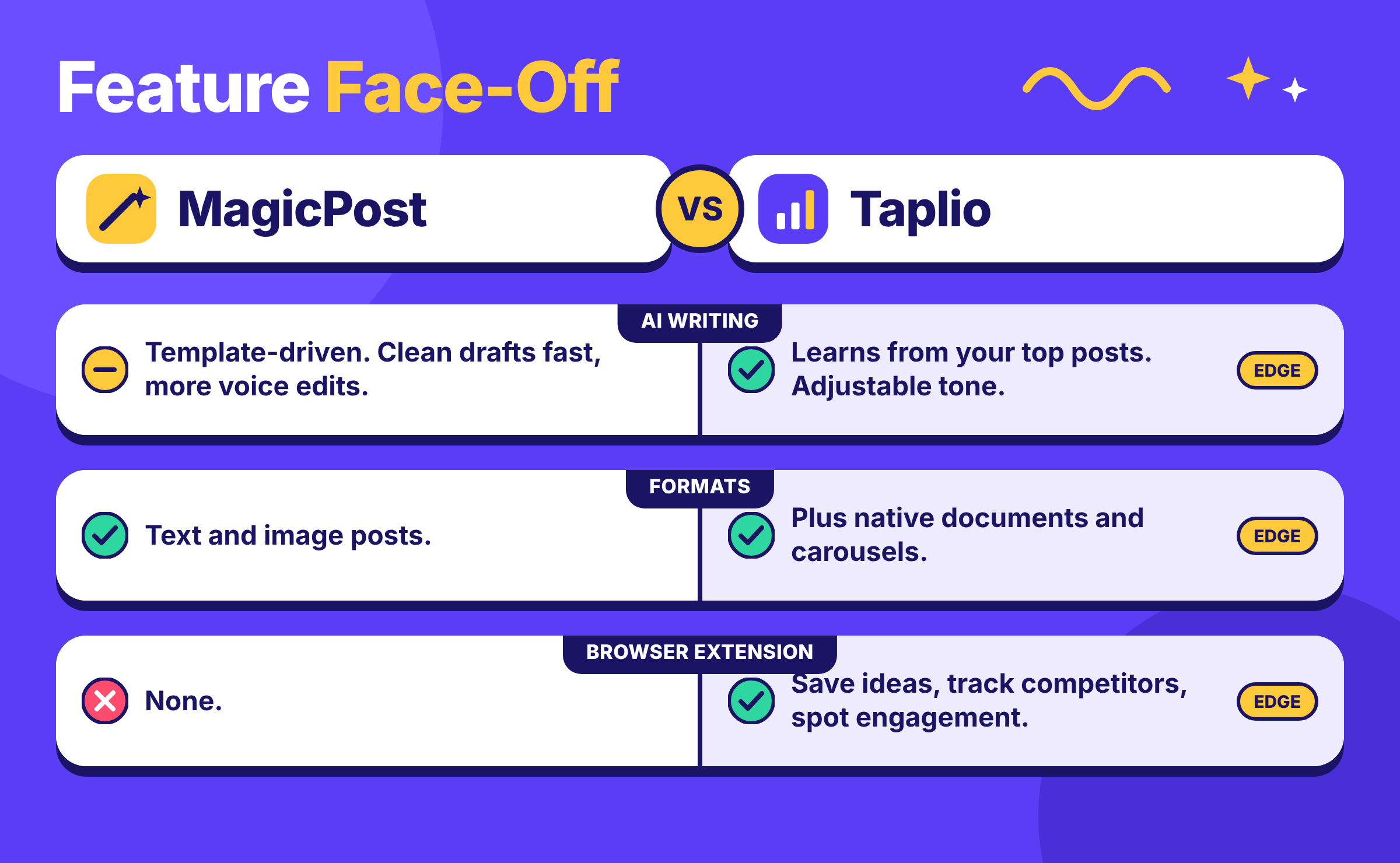
Taplio's AI writing engine has a clear edge in depth of customisation. It can learn from your past top-performing posts, adjust tone settings, and produce drafts that go beyond basic hook-body-CTA structure. MagicPost's linkedin post generator is capable but more template-driven — it produces clean, readable output quickly, but voice consistency over time requires more manual editing.
On format support: both tools handle standard text posts and image posts well. Taplio has stronger support for native document scheduling and carousel post handling, which matters for B2B content that relies on slides and PDF-style posts. Teams that skip native document scheduling and post PDFs as link previews instead typically see noticeably lower reach — LinkedIn's algorithm distributes native documents to more first-degree connections than external links.
The taplio chrome extension remains a genuine differentiator. It lets you save post ideas, track competitors' content, and spot engagement opportunities without leaving LinkedIn. MagicPost has no equivalent browser tool.
LinkedIn Algorithm Safety: Does Scheduling Hurt Your Reach?
This is the question most articles avoid answering directly. According to data from BearConnect (2026), scheduled posts achieved 97% of the engagement that manually posted content received across their analysis. In practice, the scheduling tool itself is not what suppresses reach — what suppresses reach is posting at the wrong time, using third-party link previews instead of native formats, or going quiet for extended periods.
97%
Engagement retention rate for scheduled vs manually posted LinkedIn content
What consistently separates accounts with strong organic reach from those that plateau is not whether they schedule — it is whether they post natively, engage in comments within the first 60 minutes, and maintain a consistent cadence. According to DemandBird's LinkedIn data analysis, weekly posters saw a +9% year-over-year engagement gain, while infrequent posters experienced a −25% median engagement loss. That gap is about consistency, not scheduling mechanics.
⚠️
Warning:Accounts that drop below 3 posts per week typically see algorithmic reach decay within 10–14 days. Recovery usually takes 3–4 weeks of consistent posting to rebuild prior distribution levels — regardless of which LinkedIn scheduling tool you use.
Taplio Pricing vs MagicPost Pricing: Is Either Tool Worth It?
MagicPost vs Taplio pricing comparison and feature breakdown
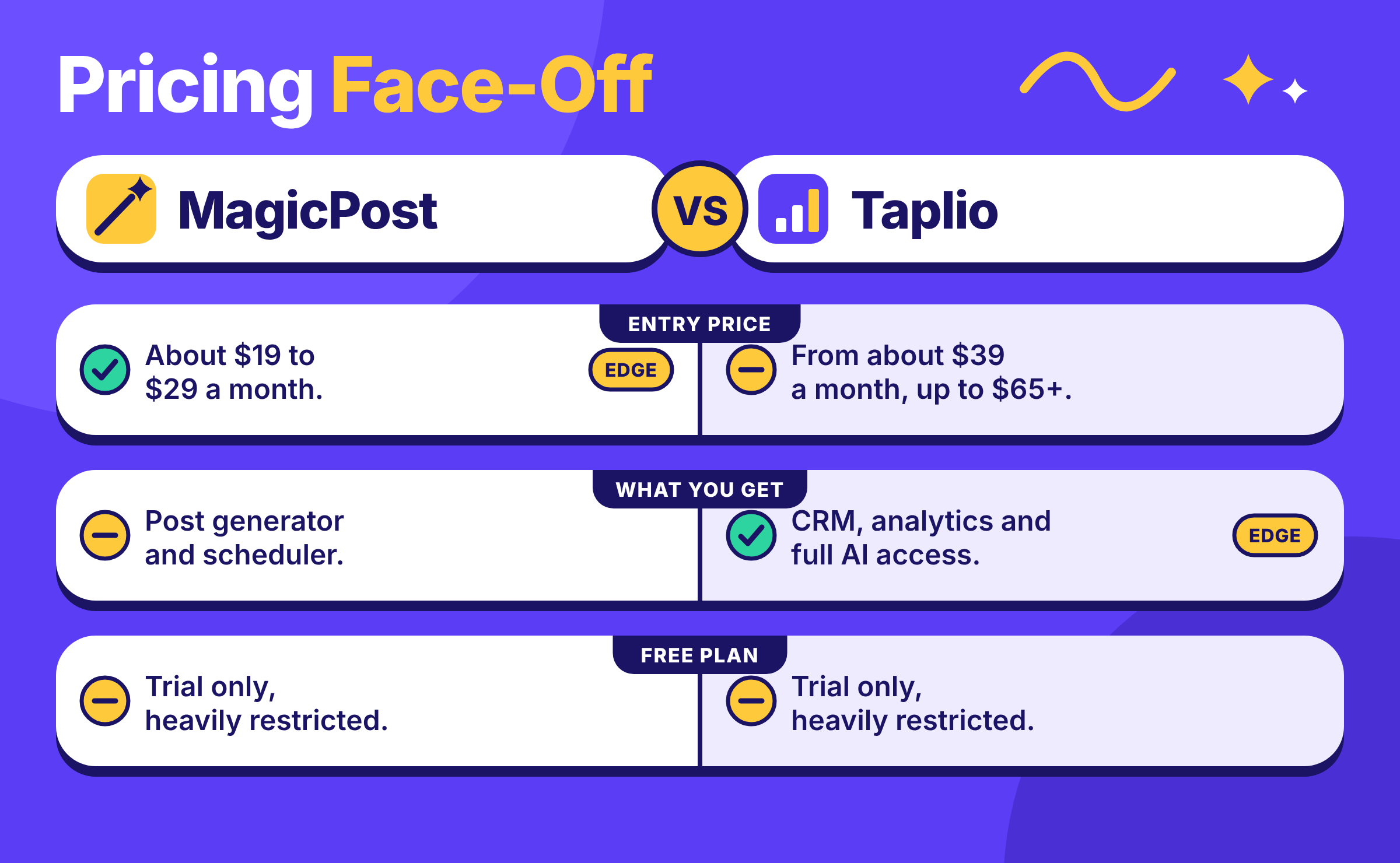
Taplio pricing plans for 2026 start at around $39/month for a basic tier and rise to $65+/month for the plan that includes CRM features, advanced analytics, and full AI access. That price is reasonable for a power user who actively uses the relationship management layer. For someone who only needs a linkedin post scheduler and AI drafts, the CRM features add cost without adding value.
MagicPost sits at a lower price point — typically around $19–$29/month — making it noticeably more accessible for freelancers and individual creators. The honest answer to "Is MagicPost cheaper than Taplio and what do you get for the price?": yes, it is cheaper, and you get a clean, functional post generator and scheduler without the analytics or CRM depth. If that is all you need, MagicPost delivers solid value.
"Is Taplio worth it for LinkedIn growth?" — honestly, it depends on your use case. For a B2B professional actively working their LinkedIn network as a sales or lead generation channel, yes. For a creator who wants to post consistently and grow an audience without tracking engagement data or managing contact relationships, Taplio's higher price buys features that go unused.
Neither tool offers a meaningfully useful free plan. Both have trial periods, but free tiers are heavily restricted — they are testing environments, not viable long-term options. According to Buffer's scheduling guide (2026), LinkedIn's native scheduler now allows planning up to three months in advance at no cost — a useful fallback if budget is the primary constraint, though it lacks AI writing features entirely.
The most expensive tool is not the one with the highest sticker price — it is the one you stop using after six weeks because the AI output sounds nothing like you.
Multi-Account Management and Team Workflows: Which Tool Scales Better?
For agencies and ghostwriters managing multiple LinkedIn profiles, both tools show their limits quickly. Taplio supports multiple profiles but charges per seat, which makes it expensive at scale. MagicPost's multi-account LinkedIn management is more limited — it was designed primarily for individual creators, not client-facing workflows.
The more significant gap is content approval workflow. Neither MagicPost nor Taplio offers a native client-approval link — the ability to send a draft to a client for sign-off before it publishes. For a ghostwriter managing five client accounts, this means a manual workaround: exporting drafts to Google Docs, chasing approvals over email or Slack, then returning to the tool to schedule. That friction compounds quickly at scale.
This is where Hypelio fills the gap that neither tool addresses. Hypelio is built specifically for agencies and ghostwriters managing multiple LinkedIn profiles: each client account has its own workspace, voice settings, calendar, and analytics — all accessible under one login without ever holding client passwords. Its client approval workflow sends draft posts via link for sign-off before anything publishes. The story bank captures content from voice recordings verbatim, so AI drafts are built from the client's own words rather than generic model outputs. Pricing is per connected account, billed upfront — which makes it more cost-effective than Taplio at scale. It is rated 4.8/5 on G2 and used by teams at Google, Meta, Goldman Sachs, and Accenture.
🔴
Avoid:Choosing MagicPost or Taplio for agency-scale client work. Neither was designed for secure multi-client LinkedIn management — you will hit approval workflow and voice-consistency limits quickly, and switching tools mid-client relationship is disruptive.
Managing LinkedIn for multiple clients or profiles?
Hypelio gives every account its own workspace, voice, and approval workflow — without holding anyone's password.
Knowing how to edit scheduled posts on LinkedIn — and how to delete a scheduled post on LinkedIn — is useful regardless of which tool you use, since LinkedIn's native scheduler handles the final delivery. If you have scheduled a post using LinkedIn's built-in scheduler directly, go to your profile, click "Start a post," then select the clock icon to view scheduled posts. From there you can edit the content, change the scheduled time, or delete it entirely before it publishes. Posts scheduled through third-party tools like Taplio or MagicPost must be edited or deleted within those platforms before the scheduled send time — once the tool has pushed the post to LinkedIn's queue, the native LinkedIn interface is where you manage it.
Which LinkedIn Tool Should You Actually Choose in 2026?
Here is the direct verdict by use case:
B2B professional using LinkedIn for lead generation: Taplio is the stronger pick. The CRM layer and analytics are genuinely useful when LinkedIn is an active business development channel.
Solopreneur or freelancer building a personal brand: MagicPost is the better fit. Lower cost, faster workflow, and no features you will never use.
Agency or ghostwriter managing multiple client accounts: Neither. Use Hypelio, which was built for exactly this workflow.
Creator focused on engagement and LinkedIn analytics: Taplio if you want depth; MagicPost if you want simplicity.
On taplio alternatives: beyond MagicPost, the main alternatives worth considering are Supergrow (similar positioning to MagicPost), AuthoredUp (strong on formatting and analytics), and Hypelio for anyone running LinkedIn as a service for others. Each solves a different problem — the mistake is picking based on feature lists rather than use case fit.
The most common mistake across all LinkedIn AI writing tools is choosing one, finding the AI output sounds generic after two weeks, and abandoning the tool rather than the prompting approach. Voice authenticity is what determines whether you actually keep using any best LinkedIn AI writing tool long-term. Tools that let you feed in your own words — recordings, notes, existing posts — consistently outperform tools that generate from prompts alone. After seeing this pattern across dozens of creators and agencies, the conclusion is consistent: the tool that sounds like you is the one you will still be using in six months.
✓ LinkedIn Tool Selection Checklist
☐Confirm whether you need CRM and analytics features — if not, Taplio's higher price is not justified
☐Check whether the tool supports native document and carousel scheduling, not just text posts
☐If managing client accounts, confirm the tool has a client-approval workflow before committing
☐Test the AI output quality using your own writing samples — not just the demo content
☐Verify multi-account pricing at your actual scale before signing up — per-seat costs add up fast
Want LinkedIn content that actually sounds like you?
Hypelio builds AI drafts from your own voice recordings — not generic prompts. Rated 4.8/5 on G2.
Frequently Asked Questions About MagicPost, Taplio, and LinkedIn Scheduling
What are the main differences between MagicPost and Taplio for LinkedIn content?
Taplio includes a CRM layer, deep analytics, and a chrome extension for in-browser engagement tracking — it is a fuller platform. MagicPost is a leaner post generator and scheduler without the relationship management features. Taplio costs roughly twice as much as MagicPost. The right choice depends on whether you need the analytics and CRM, or just reliable AI drafting and scheduling.
Which LinkedIn tool is better for someone who posts daily content?
For daily posting volume, MagicPost's faster drafting workflow is often more practical — it generates and schedules posts with less friction. Taplio is better suited to users building a network strategy around content, not just publishing cadence. Daily posters who also want to track engagement trends will find Taplio's analytics worth the extra cost.
Is MagicPost cheaper than Taplio, and what do you get for the price?
Yes. MagicPost typically costs around $19–$29/month versus Taplio's $39–$65+/month. For the lower price, MagicPost gives you AI post generation and scheduling. Taplio's higher tiers add CRM features, advanced analytics, and the chrome extension. If you only need a linkedin post scheduler with AI drafts, MagicPost offers better value per pound.
Should I use Taplio or MagicPost if I am a freelancer building my LinkedIn brand?
MagicPost is the stronger fit for most freelancers. It costs less, has a shorter learning curve, and covers the core need: consistent, well-structured LinkedIn posts without spending hours writing. Taplio makes more sense once you are actively using LinkedIn for lead generation and want to track who engages with your content and follow up systematically.
What is the best LinkedIn scheduling tool, and can I use one for free?
The best LinkedIn content creation tool depends on your use case — Taplio for analytics-driven growth, MagicPost for lean solo publishing, Hypelio for agency and ghostwriting workflows. Free options are limited: LinkedIn's native scheduler is free and allows planning up to three months ahead, but has no AI features. Both Taplio and MagicPost offer trials, but their free tiers are heavily restricted.
Does using a LinkedIn post scheduler suppress organic reach?
No — not in any meaningful way. Scheduled posts achieve approximately 97% of the engagement of manually posted content, according to BearConnect's 2026 analysis. Reach suppression is typically caused by posting at off-peak times, using external link previews instead of native formats, or inconsistent posting frequency — not by the act of scheduling itself.
Written by the team behind Hypelio. We publish what we have actually seen work across the accounts we help run — and say so plainly when something did not.
Writing the post is the easy part
The hard part is the next one, and the one after that, still sounding like you. Hypelio drafts in your voice, keeps the queue full, and works the same whether you run one account or twenty.